
Two pavilions can share the exact same posts, the exact same beam size, even the exact same footprint, and still behave completely differently once weather shows up. The variable that changes everything sits at the top.
Roof type determines how much rain stays out, how much wind the structure can take, how the timber joinery actually gets to show itself, and how much the whole build ends up costing. Most buyers spend their planning time on wood species and joinery style, then treat the roof as a final decision made from a paint chip. It deserves more attention than that. Here’s what each common roof type actually does, and how to land on the right one.
Gable Roof: The Default for a Reason
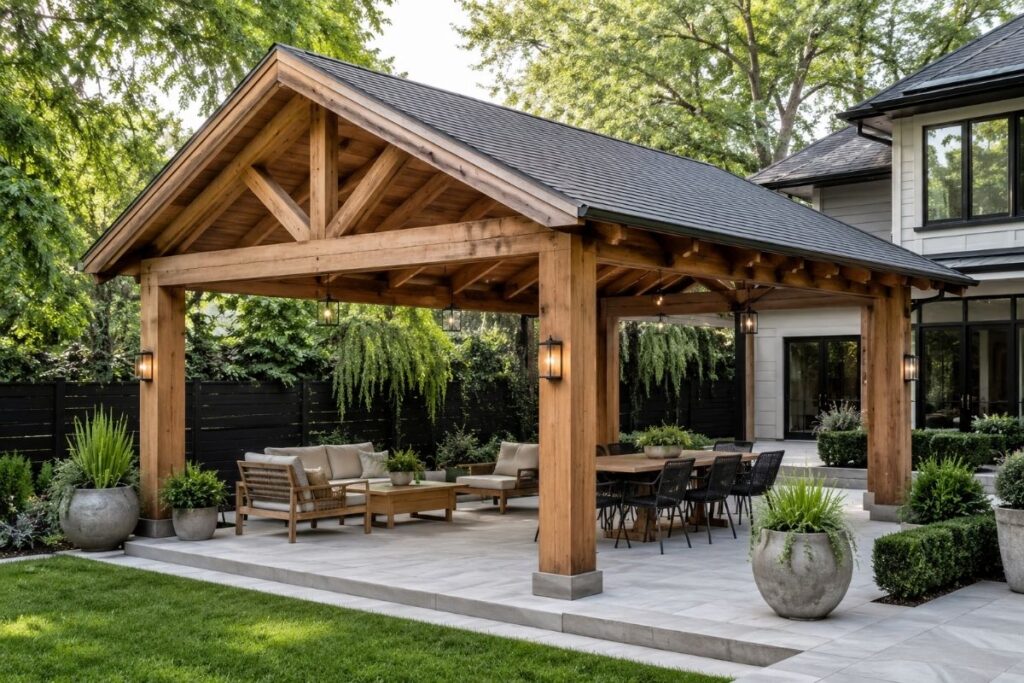
A gable roof is the shape most people draw automatically when asked to sketch a roof. Two sloped planes meet at a central ridge, with open triangular ends on either side of the structure.
This is the standard choice for timber frame pavilions, and it earns that position honestly. The open gable ends let the timber joinery show through clearly from the side, which matters if the exposed beams and pegs are a big part of why you wanted timber frame construction in the first place. It’s also the simplest shape to lay out and cut, which keeps both material waste and labor cost lower than more complex roof geometries.
The tradeoff shows up in wind-driven rain. Since the gable ends are open rather than sloped, a storm coming in at an angle can push rain further into the seating area underneath than a roof style that slopes on all four sides. The fix most builders use is a deeper rake overhang at each gable end, which extends the roofline further out and meaningfully cuts down on how much weather gets pushed inside during a sideways storm.
A gable roof also provides better natural ventilation than other styles, since the open ends allow airflow to move through more freely. In hot, humid climates, this can make a real difference in how the space actually feels to sit in during peak summer afternoons.
Hip Roof: Built for Exposure
A hip roof slopes on all four sides instead of two, with the planes meeting at a central ridge or peak rather than leaving open gable ends.
This shape trades some of the gable roof’s simplicity for noticeably better weather performance. With no open ends for wind-driven rain to exploit, a hip roof keeps more of the seating area dry during a storm, which matters a lot if there’s a dining table or outdoor kitchen positioned under the structure. The four-sided slope also distributes wind load more evenly across the frame, which is part of why hip roofs show up so often in regions that deal with high winds, heavy rain, or significant snow load.
The visual trade-off is that hip roofs partially obscure the timber framing from certain angles, since there’s no open gable end giving a clear side view into the rafters and ridge beam. Some builders address this by adding a smaller secondary gable as an accent on one elevation, which brings back a bit of that exposed-timber look without sacrificing the hip roof’s overall weather performance.
Construction complexity is the other factor worth knowing. Hip roofs require hip rafters running diagonally from each corner up to the central peak, and laying out those angles correctly takes more skill and more time than a straightforward gable. That complexity shows up in the final price, with hip roofs typically running higher than an equivalent gable design.
Gambrel Roof: More Headroom, More Detailing
A gambrel roof uses two distinct slopes on each side rather than one continuous plane, a steeper lower slope and a shallower upper one, creating the barn-style silhouette most people associate with classic American farm buildings.
For a pavilion, the main appeal of a gambrel roof is the extra interior volume it creates. The steeper lower slope effectively raises the usable headroom near the eaves, which can make a real difference if you’re planning a tall feature like a stone fireplace or want the structure to feel more spacious from below. Gambrel roofs also carry a distinct, recognizable charm that fits naturalistic or farmhouse-style landscaping particularly well.
The complexity cost is real here too. Where the upper and lower slopes meet creates an additional seam that needs careful flashing and detailing to stay watertight, and that transition point is where the majority of gambrel roof problems eventually show up if it wasn’t built correctly the first time. Gambrel roofs also tend to perform worse in high wind than a hip roof, since the steep lower slopes and vertical gable ends can catch wind in a way a more aerodynamic hip shape avoids. This roof style suits calmer climates and architectural intent more than it suits a coastal or high-wind property.
Monitor and Triple Gable Roofs: Built to Stand Out
A monitor roof raises a central section of the roofline higher than the rest, often with its own small set of windows or vents built into the raised portion. A triple gable roof takes a related approach, combining a central peak flanked by two smaller side gables into one bold, symmetrical roofline.
Both styles exist mainly to do something a basic gable can’t: create a visual focal point and, in the monitor’s case, add genuine functional benefit through extra light and airflow at the building’s center. A triple gable layout also has a practical side effect worth knowing about, since the natural break between the central and side sections tends to define distinct zones underneath, making it easier to separate a dining area from a lounge or cooking zone without adding any walls.
These styles cost more than a standard gable or hip roof, simply because there’s more roofline, more framing complexity, and more flashing detail involved. They tend to show up most often on larger pavilions, equestrian-style barns, or properties where the structure is meant to function as a genuine architectural statement rather than a purely functional shade structure.
Roofing Material: The Other Half of the Decision
Roof shape determines the silhouette, but the material on top of it determines how the roof actually performs day to day.
Architectural shingles remain a common, cost-effective choice, particularly when the goal is matching the look of the main house. Standing seam metal roofing has become the more popular upgrade in recent years, offering better longevity, lower long-term maintenance, and stronger performance against wind uplift than shingles typically provide. Heavy-gauge aluminum is worth considering in coastal or high-humidity regions specifically, since it resists corrosion in a way steel panels can struggle with over a long enough timeline.
Whichever roof shape you land on, the material choice deserves its own separate conversation rather than getting decided as an afterthought once the framing plan is finalized.
How to Actually Choose the Right Roof Type
Start with your climate before anything else. Heavy rain, high wind, or significant snow load all point toward a hip roof’s superior weather performance over a standard gable. Mild, dry climates remove most of that pressure and open the door to choosing based on appearance and budget instead.
Next, think about how much you want the timber joinery itself on display. If the exposed beams, pegs, and rafter tails are a major part of why you wanted a timber frame structure in the first place, a gable roof shows that craftsmanship off far better than a hip roof does.
Finally, factor in budget honestly. A standard gable roof is consistently the most affordable option to build correctly, while hip roofs, gambrel roofs, and multi-gable designs each add cost in proportion to how much additional framing complexity they introduce.
Frequently Asked Questions
Which roof type is best for heavy snow regions?
A hip roof generally performs best in heavy snow areas, since its four-sided slope distributes weight more evenly and avoids the open gable ends that can let wind-driven snow accumulate against exposed framing.
Does roof type affect how visible the timber joinery is?
Yes. Gable roofs leave the framing fully visible through the open ends, while hip roofs and gambrel roofs partially or fully obscure that view depending on the specific design and overhang depth.
Is a hip roof always more expensive than a gable roof?
In most cases, yes. The diagonal hip rafters and more complex framing layout require more material and labor than a standard gable, which typically shows up as a noticeably higher cost for an equivalent size structure.
Can I mix roof styles on one pavilion?
Yes, designs like the triple gable combine a central gable with smaller side gables, and some builders add a secondary accent gable to an otherwise hip-roofed structure. These hybrid approaches cost more but can balance weather performance with the visual appeal of exposed timber framing.
Conclusion
The roof on a timber frame pavilion isn’t just a finishing touch, it’s the component that decides how the structure actually performs once real weather shows up. Choose a gable roof for the classic look and the lowest cost, a hip roof if your climate demands better wind and rain performance, and a gambrel or multi-gable design if you want the structure to double as a genuine architectural statement. Whichever shape you land on, get the roofing material decision right alongside it, since the two choices together determine how the pavilion holds up for the next several decades.