
Pavilion vs Gazebo: Key Differences in Design and Use
Ask three contractors for a gazebo quote and you might get three completely different structures back. One assumes you mean a small octagonal kit. Another assumes a covered patio. A third asks if you actually mean a pavilion.
This mix-up isn’t rare. People use “gazebo” as a catch-all term for almost any roofed backyard structure, the way “Kleenex” gets used for any tissue. The two structures genuinely differ in shape, function, and what they’re actually good for, and knowing the distinction before you start collecting quotes saves you from comparing prices on two completely different products.
Shape Is Where the Real Difference Starts
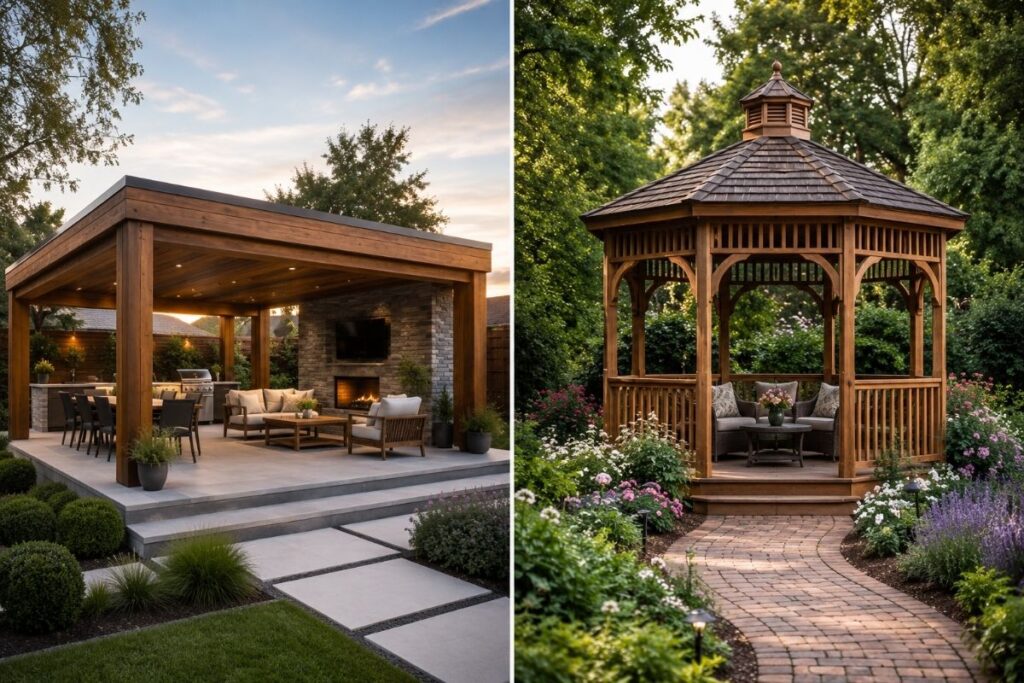
Everything else about these structures traces back to one decision: the footprint.
A pavilion uses a rectangular or square footprint, the same shape as a room. This shape mirrors how people actually use indoor space, with furniture arranged along walls or around a central table, and it scales easily in one direction without throwing off the proportions.
A gazebo uses a round or octagonal footprint instead. Every wall, if you can call them that, sits the same distance from the center, which creates a naturally symmetrical space but also limits how furniture gets arranged. You’re working with wedge-shaped zones around a circle rather than a flat rectangular room.
That geometric choice is also why gazebos cost more per square foot to build well. A rectangular frame uses standard angles and repeatable joints. An octagonal frame requires compound angles at every connection point, which takes more precision and more shop time to get right.
Roof Style Follows the Shape
Once you know the footprint, the roof style mostly explains itself.
A pavilion roof typically uses a gable or hip design, two long rectangular planes meeting at a ridge line, similar to the roof on a house. This shape sheds rain efficiently and allows the structure to span much wider distances without needing extra support in the middle.
A gazebo roof comes to a central peak instead, often built with a cupola or decorative cap at the very top for visual flair. This roof style looks distinct from every angle, since the symmetry means there’s no “front” or “back” the way a pavilion has. It’s also a roof style that’s inherently limited in span, since extending an octagonal roof too far makes the structural math much harder to manage.
Size: Pavilions Scale Up, Gazebos Stay Compact
This is where the practical difference really shows up for most homeowners.
A residential gazebo typically falls somewhere between 8×8 and 14×14 feet measured across its widest points, comfortably seating somewhere around five to fifteen people depending on layout. Push much past that range and the structural challenges of the polygonal shape start working against you.
A residential pavilion commonly starts around 12×16 and scales up to 20×30 or larger without much added complexity, since a rectangular frame just keeps adding bays of the same repeated structure. If you’re picturing a space for a full outdoor kitchen, a long dining table, and a separate lounge area, a pavilion gets you there. A gazebo, by design, doesn’t.
Open Sides vs Enclosed Charm
This difference affects how the space actually feels to sit in, more than any other factor on this list.
Pavilions are built with fully open sides as the default. Posts hold up the roof, and nothing fills the space between them unless you add something intentionally, like retractable screens or partial privacy walls. The result is unobstructed airflow and total flexibility for arranging furniture, since there’s no railing or lattice dictating where seating has to go.
Gazebos lean the opposite direction. Railings, balusters, or latticework typically wrap around the lower portion of the structure, creating a defined, somewhat enclosed feel even though the upper half is still open to the air. This is part of what gives a gazebo its cozy, retreat-like character, but it also limits how the interior gets used. You’re working within a fixed perimeter rather than an open floor plan.
What Each Structure Is Actually Built For
The shape and openness differences add up to two structures with genuinely different jobs.
A pavilion is built for activity. Outdoor kitchens, long dining tables, ceiling fans, televisions, full entertaining setups, these all need open floor space and high clearance, which a pavilion provides by design. Many homeowners use a pavilion as a true extension of their living space, hosting gatherings there as often as they would inside the house.
A gazebo is built for a moment, not a marathon. A quiet corner for morning coffee, a focal point at the end of a garden path, a small spot for two to six people to sit and talk. The enclosed, symmetrical feel suits reading, relaxing, or simply admiring a view more than it suits hosting a crowd.
Neither use case is better than the other. They’re just different jobs, and the structure that handles one well usually handles the other poorly.
Cost and Long-Term Durability
Pricing depends heavily on size and materials, but a few patterns hold consistently across both structure types.
A basic gazebo kit can run a few thousand dollars for a smaller size, while a premium cedar gazebo with detailed millwork climbs considerably higher. Pavilions span a wider range overall, from budget kits in the low five figures to fully custom timber frame builds well into the tens of thousands, largely because pavilions scale up in size far more than gazebos typically do.
Material choice affects both structures similarly. A timber frame build with real mortise and tenon joinery outperforms a basic kit in either category when it comes to long-term durability, resisting warping and settling better than lighter, mass-produced alternatives. If either structure is going to anchor your backyard for decades rather than just a few seasons, the joinery and wood quality matter more than the shape you ultimately choose.
How to Actually Decide Between the Two
Skip the terminology debate and start with how you actually plan to use the space.
If you’re picturing dinner parties, an outdoor kitchen, or a space that functions like an additional room of the house, you’re describing a pavilion, even if you’ve been calling it a gazebo out of habit. If you’re picturing a quiet garden retreat, a decorative focal point, or a cozy spot for a small group, a gazebo is almost certainly the better fit, and probably the cheaper one too.
Once you know which job the space needs to do, the shape, roof style, and size more or less choose themselves.
Frequently Asked Questions
Can a gazebo be enclosed to function more like a pavilion?
To an extent, yes. Adding screens, curtains, or partial walls can make a gazebo more functional for entertaining, but its smaller footprint and polygonal shape still limit how much furniture and activity it can comfortably hold compared to a pavilion.
Is a pavilion always more expensive than a gazebo?
Not necessarily at smaller sizes, but pavilions scale up in size and cost far more readily than gazebos do. A small pavilion and a premium gazebo can land in a similar price range, while a large pavilion will cost significantly more than any standard gazebo.
Do both structures need a permit?
In most areas, yes, particularly once the structure exceeds a certain size or includes electrical work. Requirements vary by municipality and HOA, so it’s worth checking with your local building department before finalizing a design.
Which structure adds more value to a home?
Pavilions generally add more functional value, since they support a wider range of everyday uses like outdoor dining and entertaining. A well-built gazebo still adds aesthetic appeal and can be a strong selling point in a garden-focused landscape, but it typically doesn’t expand usable living space the way a pavilion does.
Conclusion
The pavilion vs gazebo question isn’t really about which structure looks better. It’s about which shape supports how you actually want to spend time outside. Choose a pavilion if you want an open, functional space built for gathering and daily use. Choose a gazebo if you want a smaller, more intimate retreat that earns its keep as a focal point rather than a workhorse.