
A guy on a tractor forum put it about as plainly as it gets: he’d built his door dead center on the gable end, and now every time he wants to hitch an implement, he’s fighting for room on both sides of the tractor instead of having one clear working zone. The building was the right size. The door was just in the wrong spot.
This is one of the most common regrets in post-frame construction, and it rarely gets the attention it deserves during planning. People spend weeks deciding on square footage and wall height, then treat door placement as a five-minute decision made near the end. It deserves more than that, since the doors are what determine whether the building actually works the way you need it to every single day, not just whether everything technically fits inside it.
Why Door Position Matters More Than Door Count
It’s tempting to think of door placement as a minor detail once the size and door dimensions are locked in. In practice, where a door sits changes how every square foot of the building actually gets used.
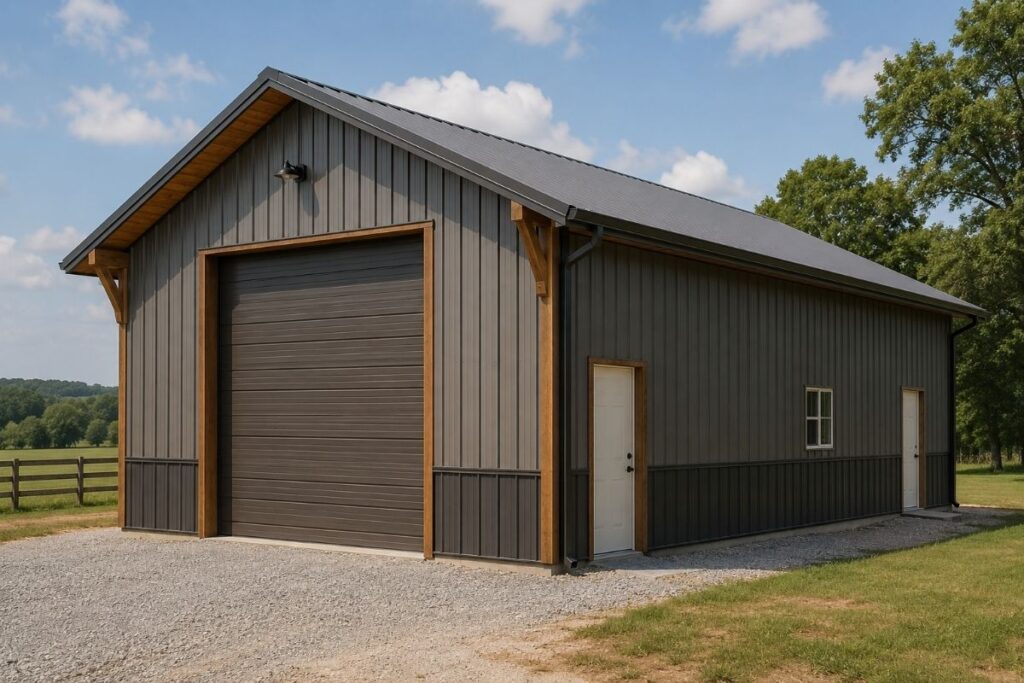
A door placed dead center on a wall splits the interior into two equal but separate working zones, which sounds balanced on paper but tends to create exactly the kind of “no clear workspace” problem the tractor owner ran into. A door offset toward one side instead leaves one large, uninterrupted zone for parking, storage, or work, with a smaller, more defined space on the other side of the opening. For most uses, that asymmetry is actually the more functional layout, even though it looks less tidy on a floor plan.
Centered vs Offset: The Hitching Problem
This comes up constantly with anyone storing tractors, trailers, or towed equipment, but the underlying lesson applies just as much to a garage or workshop.
When a door sits in the center of a wall, backing equipment in or out leaves roughly equal amounts of clearance on both sides, which sounds like it should be convenient. The problem shows up the moment you need to actually work around the equipment, hitching an implement, loading a trailer, or accessing a toolbox mounted on one side of a vehicle. With a centered door, neither side has enough uninterrupted space to do that comfortably.
Offsetting the door, typically a few feet from one corner, solves this by concentrating all your usable clearance on one side. You get a full, dedicated working zone next to the equipment, while the rest of the building stays open for storage or a second vehicle. Builders and longtime pole barn owners consistently recommend this offset approach for exactly this reason, even on buildings that don’t involve farm equipment at all.
Drive-Through vs Single-Entry Layouts
How you plan to move things in and out of the building matters as much as the door’s position on any single wall.
A single-entry layout, with one door on one side, works fine for a building that mostly stores things and doesn’t need much in-and-out traffic. The downside shows up when you need to retrieve something stored toward the back, since everything in front of it has to move out of the way first.
A drive-through layout, with doors on opposite ends of the building, solves that problem directly. Equipment or vehicles enter on one side and exit on the other without ever needing to back out the way they came in. This is especially valuable for agricultural buildings, RV storage, or any workspace where multiple vehicles need to rotate through regularly. Some owners go a step further and install two separate overhead doors on the same end rather than one large shared opening, which avoids the situation where retrieving one item means temporarily relocating everything else stored alongside it.
Door Height and Real-World Clearance
A door’s listed height doesn’t tell the whole story, and this is one of the more common planning mistakes that only becomes obvious after the building is finished.
A 12-foot overhead door doesn’t mean every piece of equipment with a 12-foot overall height moves through comfortably. Door hardware, tracks, and a small real-world safety margin all eat into that number, and tall equipment like a tractor with a cab, an RV, or anything with a raised antenna or vent needs more clearance than the door’s stated dimension suggests on paper. It’s worth measuring your tallest piece of equipment and adding a genuine buffer, not just matching the door height to the equipment height exactly.
This also connects directly to sidewall height, which is easy to underbuild and expensive to fix afterward. If there’s any chance you’ll own taller equipment, add a vehicle lift, or want loft storage down the road, planning for that clearance now costs far less than trying to retrofit it into an already-built structure.
Planning Doors Around Daily Workflow, Not Just Equipment Size
The most useful question to ask isn’t “will this fit through the door.” It’s “how will I actually move through this space on a normal day.”
For a workshop, that means thinking about where raw material comes in, where finished projects go out, and whether those two paths can avoid crossing each other constantly. For a garage with a workbench area, it means keeping the door far enough from the bench that opening a vehicle door doesn’t block access to tools. For agricultural buildings, it often means looking at how equipment already moves across the property and orienting the building, and its doors, along that existing path rather than forcing a new route.
A man door deserves its own placement thought too, separate from the larger overhead or sliding doors. A small side entry positioned near a workbench or frequently used corner saves constant trips through a large overhead door just to grab a tool or step outside briefly, and it’s a detail that’s far cheaper to plan in from the start than to add later.
Site and Climate Factors That Influence Door Placement
Beyond the interior workflow, the property itself plays a role in where doors should go.
Wind direction matters more than most first-time builders expect. A large overhead door facing straight into prevailing winter winds turns every open-door moment into an uncomfortable one, and in some regions, it can also stress the door hardware over time. Orienting the main entry away from the prevailing wind, where the site allows it, makes the building noticeably more pleasant to use through colder months.
Sun exposure plays a role too, particularly for workshop buildings where natural light through an open door or nearby windows actually affects how usable the space feels day to day. Drainage and approach angle matter on a practical level as well, since a door positioned where vehicles need a tight turn or cross uneven, low-lying ground creates a daily frustration that has nothing to do with the door itself but everything to do with where it was placed relative to the rest of the property.
Building in Flexibility for Later
A pole building rarely stays frozen in its original use, and door placement is one of the few decisions that’s genuinely difficult to change once construction wraps.
Leaving doors offset rather than spanning a wall edge to edge keeps room for future additions, like extending the building lengthwise or adding a lean-to along one side without needing to relocate an existing opening. Some buyers planning for eventual expansion intentionally place doors on the side walls rather than the gable ends specifically because it makes adding parking bays or extra length down the road much simpler than if the gable end were already filled with openings.
It’s a small amount of extra thought at the planning stage that can save a significant amount of rework if your needs grow even modestly over the next several years.
Frequently Asked Questions
Should pole barn doors be centered or offset on a wall?
Offset is generally the better choice for most uses, since it concentrates usable clearance on one side of the door rather than splitting it evenly, which makes tasks like hitching equipment or working around a vehicle significantly easier.
What’s the advantage of a drive-through layout with doors on both ends?
A drive-through layout lets vehicles or equipment enter on one side and exit the other without backing out, which saves time and avoids the need to move other stored items out of the way to retrieve something parked toward the back.
How much extra clearance should I plan beyond my equipment’s height?
It’s wise to add a genuine buffer beyond your tallest equipment’s measured height, since door hardware, tracks, and real-world variables like antennas or roof vents all reduce the usable clearance below the door’s stated dimension.
Does door placement affect future building expansion?
Yes. Doors placed on side walls, with some room left rather than filling the wall edge to edge, make it considerably easier to extend the building’s length or add a lean-to later without needing to relocate existing openings.
Conclusion
Door placement is one of the cheapest decisions to get right during planning and one of the most expensive to fix afterward. Think through how you’ll actually move through the space day to day, offset doors rather than centering them when equipment access matters, and build in enough clearance and flexibility that the building still works for you a few years from now, not just on the day it’s finished.