
The word “complete” is doing a lot of work in this industry. Most kit listings carry an asterisk somewhere near that word, and the fine print underneath it is usually where the real planning starts. Nails, insulation, doors, windows, and concrete are routinely sold separately, even on packages marketed as complete materials kits.
That’s not a scam, it’s just how the industry defines the term. A complete kit means everything needed for the structural shell, framing, and exterior skin. It doesn’t necessarily mean everything needed to actually finish and use the building. Knowing exactly where that line sits before you order saves you from a budget surprise once the truck shows up.
What “Complete” Actually Includes
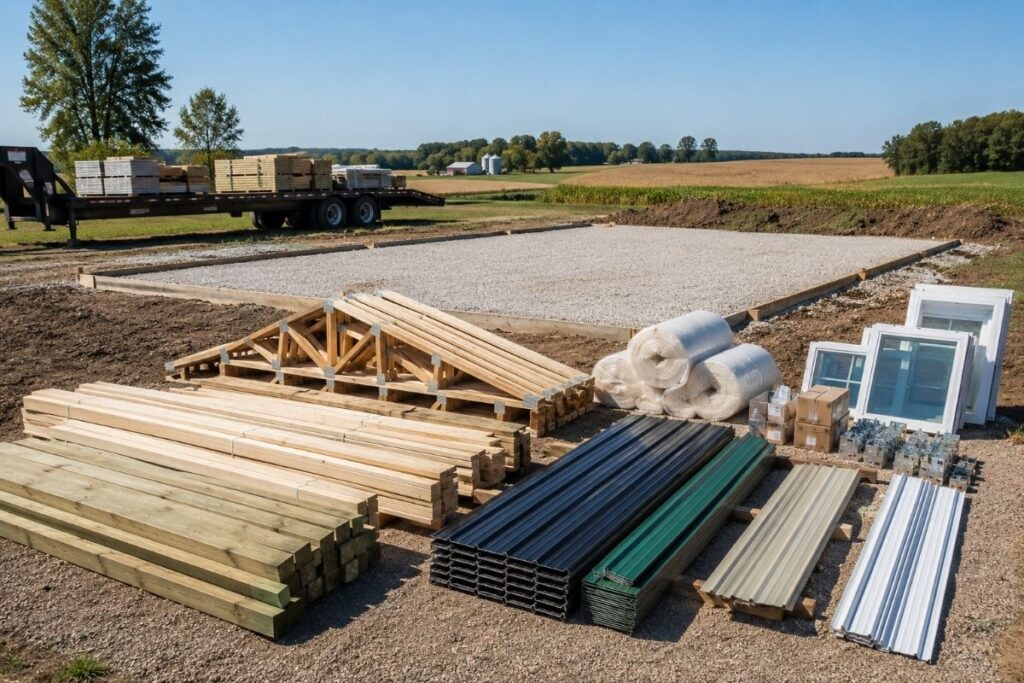
A genuine structural kit covers the components that form the building’s frame and shell. That starts with structural posts, typically pressure-treated lumber sized to the building’s height and load requirements, which form the main support system and get set directly into the ground or onto concrete footings.
Engineered roof trusses come next, designed specifically for the building’s dimensions and rated for the snow and wind loads at your location rather than a generic, one-size-fits-all spec. Wall girts and roof purlins round out the framing, running horizontally between posts and across the trusses to give the metal panels something to attach to. Metal roofing and siding panels make up the exterior skin, along with the fasteners, trim, and closure strips needed to actually install them correctly and keep moisture out at every seam and transition.
Most reputable kits also include engineered, stamped building plans, which your local permitting office will require regardless of how simple the structure looks on paper. Without these stamped plans, getting a permit approved can stall the entire project before construction even starts.
What’s Commonly Left Out
This is the part worth reading carefully before you compare prices between suppliers, since two kits priced very differently might actually include very different scopes.
Concrete is almost always excluded from the base kit price. Whether that’s footings for the posts or a full floor slab, concrete work is typically priced and poured separately, partly because the right concrete spec depends heavily on local soil conditions and the building’s intended use. Fasteners like nails are sometimes excluded too, despite seeming like they’d obviously be part of a “complete” package, simply because suppliers don’t want to guess at exact quantities for a DIY build.
Doors and windows are another common gap. Some kits include a garage door opening and personnel door opening framed into the design, but the actual doors themselves, along with any windows, often get priced as add-ons rather than baseline inclusions. Insulation almost never comes standard, since whether you need it, and how much, depends entirely on whether the building will be heated, cooled, or left as basic cold storage.
The fix here is simple but easy to skip: ask for an itemized materials list before you compare quotes, not just a total price. A kit that looks $4,000 cheaper might just be excluding doors and concrete that a competitor’s quote already included.
Standard Sizes and What They’re Built For
Pole building kits scale from compact backyard structures up to commercial-sized buildings, and sizing them correctly from the start matters more than almost any other decision in the planning process.
Small kits in the 12×22 to 20×30 range suit single-vehicle garages, basic storage, or a light hobby shop, and they’re the most budget-friendly entry point into post-frame construction. Mid-size kits, generally 24×24 up through 30×40, cover the most common residential use case: a two-car garage with enough leftover depth for a workbench or storage shelving along one wall. This range is consistently the most frequently ordered size category across suppliers, since it balances cost against genuine day-to-day usefulness.
Larger kits in the 40×60 and up range step into combo garage-workshop territory, RV and equipment storage, or small commercial use, where the extra width and length support multiple vehicle bays alongside a dedicated work zone. Beyond that, kits scaling toward 60×100 and larger move into agricultural and light industrial territory, typically requiring more customized engineering rather than a standard pre-designed package.
Height matters just as much as the footprint, and it’s the dimension first-time buyers most often underbuild. Standard eave heights run from 10 to 12 feet for residential use, while buildings meant for RV storage, taller equipment, or a future loft commonly need 14 to 16 feet or more. Since height is far more expensive to add after construction than to plan for upfront, it’s worth erring generous here even if you’re not certain you’ll need the extra clearance immediately.
Truss Pitch and Spacing
Most standard kits default to a 4/12 roof pitch with trusses spaced four feet on center, a configuration that balances material cost against structural performance for typical wind and snow conditions. Steeper pitches or tighter truss spacing are available, usually as upgrades, for regions with heavier snow load or for buyers who want a steeper roofline for aesthetic reasons.
This default spec is worth confirming against your actual local code requirements rather than assuming it applies everywhere. Snow load and wind load requirements vary significantly by region, and a kit engineered for one part of the country may need adjustment before it’s legally buildable in another.
Planning Steps Before You Order
A few steps, done in the right order, prevent most of the headaches that show up after a kit gets delivered.
Start with your local building department, not the kit supplier. Confirm permit requirements, setback rules, and any local snow or wind load amendments before finalizing a design, since these requirements directly affect what specifications the engineered plans need to meet. Skipping this step risks ordering a kit that doesn’t actually satisfy your jurisdiction’s requirements once you submit for permit review.
Next, get a genuinely itemized quote, not just a total price. Ask specifically what’s included for concrete, fasteners, doors, windows, and insulation, since these are the line items most likely to differ between suppliers even when their headline prices look similar.
Confirm delivery logistics before committing too. Some suppliers include delivery within a defined service region and charge extra outside it, and lead times can vary from a few weeks for a standard small kit to considerably longer for a custom or larger commercial package. Knowing your actual timeline matters if the build is tied to a season, a move-in date, or a deadline of any kind.
Finally, plan size with some room for growth rather than sizing strictly to your needs on day one. Because post-frame construction scales up in price far more gently than traditional stick-built construction, the cost difference between a building that’s just barely big enough and one with genuine room to spare is often smaller than people expect, and it’s a difference that’s only affordable to fix before construction starts.
Frequently Asked Questions
Does a “complete” pole building kit include concrete?
Almost never. Concrete for footings or a floor slab is typically priced and installed separately, since the correct specification depends on local soil conditions and how the building will be used.
Are doors and windows included in a standard kit?
Often the openings are framed into the design, but the actual doors and windows themselves are frequently sold as separate add-ons rather than included in the base kit price. Always confirm this before comparing quotes.
What size pole building kit is most commonly ordered?
The 24×24 to 30×40 range is the most popular size category for residential buyers, since it comfortably handles a two-car garage along with some workspace without stepping up to a significantly larger budget.
How do I know if a kit meets my local building code?
Engineered, stamped plans included with a reputable kit should reflect your specific location’s snow and wind load requirements. Confirm this directly with the supplier and cross-check with your local building department before ordering.
Conclusion
A complete pole building kit gets you the structural shell, but rarely the entire finished building, and the gap between those two things is exactly where most budget surprises happen. Get an itemized materials list, confirm what’s excluded before you compare prices, and size the building with a bit of room to grow. The planning time spent here costs nothing and saves considerably more once the materials actually arrive at your site.