
Search this comparison and most of what comes up was written by a steel building company. Wood rots, steel doesn’t, buy steel, the math is presented as settled. It isn’t quite that simple, and the marketing around this decision tends to flatten a comparison that actually depends a lot on your specific project, your site, and how long you plan to own the building.
Both structures use steel panels for roofing and siding, which is exactly why people assume they’re nearly the same product. They aren’t. The framing system underneath is completely different, and that difference drives almost every other decision in this comparison, from upfront cost to how the building performs fifteen years from now.
What Actually Separates the Two
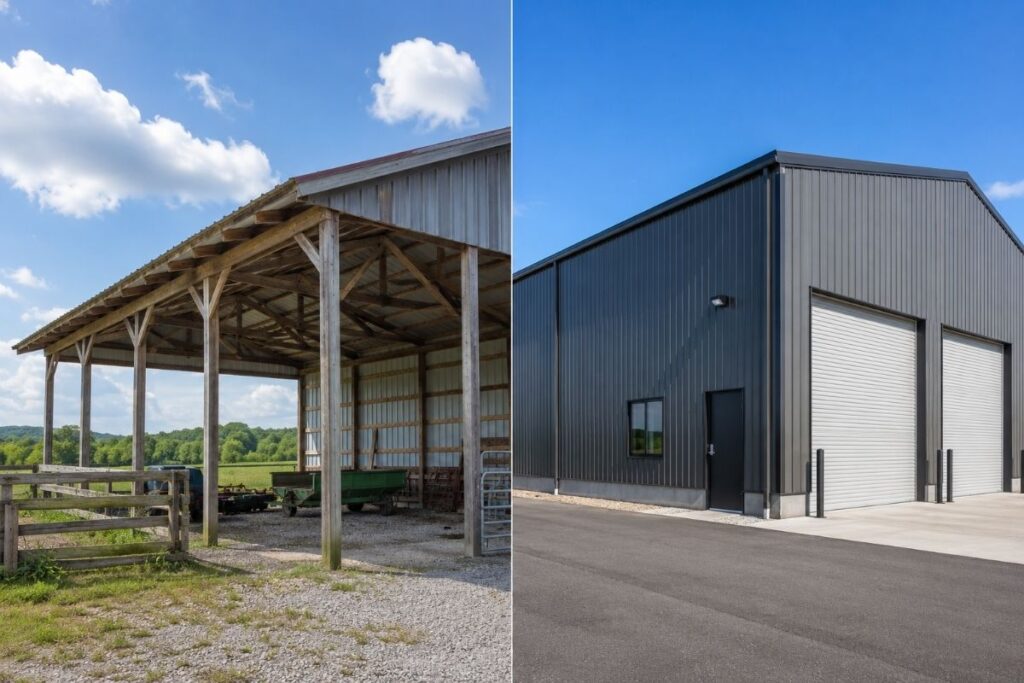
A pole barn, also called a post-frame building, uses wooden posts as its primary structural system. Those posts get set directly into the ground or anchored on concrete footings, with wood trusses and framing connecting them, and steel panels attached on top for the exterior.
A steel building uses a fully engineered steel frame instead, with columns bolted to a concrete foundation rather than buried in the ground. The steel panels on a metal building aren’t just exterior cladding the way they are on a pole barn, they’re attached to a load-bearing steel skeleton underneath.
This is the root of nearly every difference that follows. A pole barn’s foundation is essentially built into its framing system. A steel building’s foundation is a separate, more demanding piece of the project that has to be engineered correctly before the steel frame can even go up.
Upfront Cost: Where the Numbers Actually Land
For small to mid-size structures, pole barns are typically 15 to 30 percent cheaper than a comparable steel building. A pole barn shell generally runs somewhere between $15 and $35 per square foot installed, while a steel building usually lands between $17 and $40 per square foot for the building itself.
That gap narrows, and sometimes flips, once you factor in the full project cost rather than just the building package. This is where a lot of comparisons get misleading. A pole barn’s post-frame system often needs nothing more than a simple footing or gravel floor to function structurally, while a steel building generally requires a full engineered concrete slab or pier-and-beam foundation before the frame is even delivered. In side-by-side comparisons that include realistic foundation and sitework costs, a steel building’s total project price can end up tens of thousands of dollars higher than an equivalent pole barn kit, even when the steel building’s listed price looked competitive at first glance.
The honest takeaway here is that comparing sticker prices alone tells you very little. Get a full quote that includes foundation work for both options before deciding which one is actually cheaper for your specific site.
Long-Term Maintenance and Insurance
This is the area where steel genuinely earns its reputation, and it’s worth taking seriously even though it often gets oversold.
Wood posts, even pressure-treated ones, are vulnerable to rot, pest damage, and gradual movement as the surrounding soil shifts with seasonal moisture changes. Over a long enough timeline, that means periodic post straightening, fastener checks, and the possibility of replacing a post that’s deteriorated below ground, which is a genuinely difficult and expensive repair. Steel framing doesn’t share these vulnerabilities. It doesn’t rot, doesn’t attract termites, and isn’t subject to the same kind of structural movement.
Insurance reflects this difference. Steel buildings often qualify for meaningfully lower premiums than wood pole barns, sometimes by 30 percent or more, since insurers price in the lower fire risk and reduced likelihood of structural claims over the building’s life. If insurance cost is a major factor in your decision, it’s worth getting actual quotes for both building types in your area rather than assuming the difference is marginal.
Lifespan and Long-Term Value
Steel buildings typically carry longer expected lifespans, often cited in the 50 to 75-plus year range compared to 40 to 60 years for a well-maintained pole barn. The weakest point in any pole barn is consistently the treated wood posts in contact with the ground, since even quality treatment eventually loses ground against decades of soil moisture exposure.
That said, “shorter lifespan” doesn’t mean short. A properly built and maintained pole barn easily outlasts most ownership periods, and the gap in practical terms matters most for buyers planning multi-generational use or treating the structure as a long-term commercial asset rather than a personal garage or hobby shop.
Steel buildings also tend to hold resale value better and come with longer manufacturer warranties, sometimes up to 40 years versus shorter coverage typical of pole barn kits. Some jurisdictions and appraisers treat steel buildings as more clearly “permanent” structures too, which can matter if the building’s value needs to be reflected accurately on a property appraisal down the road.
Span, Expansion, and Future Flexibility
If you need a wide-open interior with minimal interior columns, steel has a real structural advantage. Steel buildings can clear-span considerably wider than wood framing typically allows, which matters for large equipment storage, aircraft hangars, or any use where interior columns would genuinely get in the way.
Expansion later is also generally easier with steel. Many steel building kits include expansion-ready end walls, designed specifically so a future addition can bolt onto the existing frame with minimal rework. Expanding a pole barn is possible, but it usually requires more significant structural modification since the original post layout wasn’t necessarily designed with a future addition in mind.
Build Timeline and DIY Feasibility
Pole barn kits typically ship faster, often within two to six weeks of ordering, with construction taking one to three weeks for a straightforward build. Steel building kits generally have longer lead times, often six to sixteen weeks from order to delivery, given the more complex manufacturing process behind a fully engineered steel frame.
DIY feasibility also differs. Pole barn construction, while still demanding real skill, is more approachable for an experienced DIYer or a small local crew. Steel building assembly involves heavy components, precise bolt-up connections, and a rigid frame system that most manufacturers strongly recommend installing through an authorized crew rather than attempting without specialized experience.
Which One Actually Makes Sense for Your Project
For a residential garage, workshop, or hobby building under roughly 3,000 square feet, a pole barn is usually the more practical choice. It’s cheaper, faster to build, easier to customize on a budget, and perfectly capable of handling the kind of use most homeowners actually need.
A steel building starts making more sense as the project scales up, particularly past 5,000 square feet, or when the building needs a wide clear span, will see heavy commercial use, sits in a region with extreme weather exposure, or is intended as a long-term investment where lower lifetime maintenance and insurance costs genuinely offset the higher upfront price.
If you’re building on expansive or unstable soil, that consideration can tip the decision in steel’s favor regardless of size, since a steel building’s engineered concrete foundation handles ground movement more predictably than buried wood posts.
Frequently Asked Questions
Is a pole barn always cheaper than a steel building?
Usually for smaller structures, yes, but the gap shrinks or can disappear once full foundation and sitework costs are included. Always compare complete project quotes rather than just the building kit price before deciding.
Which building type lasts longer?
Steel buildings typically last longer overall, often 50 to 75-plus years compared to 40 to 60 years for a pole barn, mainly because the treated wood posts in a pole barn eventually weaken from prolonged ground contact.
Can either building type be expanded later?
Both can be expanded, but steel buildings are generally easier to extend, since many kits include expansion-ready end walls designed for future additions. Pole barn expansion is possible but often requires more structural rework.
Do I need a concrete foundation for a pole barn?
Not necessarily for the structure itself, since posts can be set directly in the ground or on simple footings. Many owners still add a concrete slab for the floor, but it isn’t always required to support the building structurally the way it is for a steel frame.
Conclusion
There’s no universally correct answer between a pole barn and a steel building, despite how confidently either side of this debate gets argued online. A pole barn wins on upfront cost, build speed, and DIY accessibility for most residential and small commercial projects. A steel building wins on long-term durability, insurance cost, span capability, and future expansion once a project scales up or faces genuinely demanding site conditions. Get real quotes for both, including full foundation costs, before deciding which one actually fits your project and your timeline.